
Review · WALKING TOURS
Guided Walking City Tour in Almaty
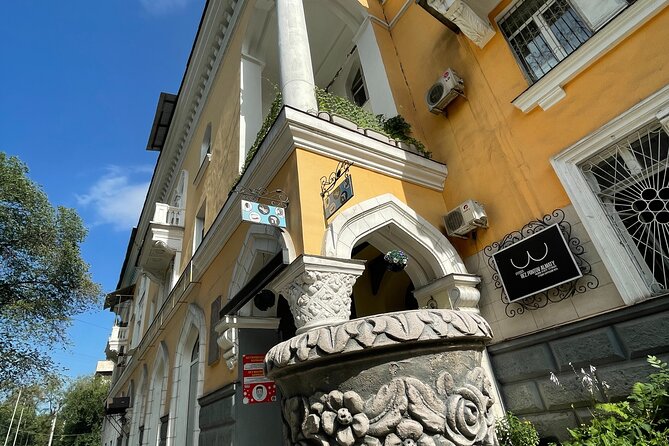
Almaty reveals its past one building at a time. This private three-hour walk links the city’s Silk Road beginnings with its Russian imperial, Soviet, and independent Kazakh eras. I like the unusual architecture, including the string-bag-shaped telegraph building and the so-called Stalin cake house. I also like the clear historical thread, from water systems and building materials to earthquakes and city planning.
The main drawback is focus. The tour description promises a broad look at Almaty, but the experience may lean heavily toward buildings and urban design. If you want food, politics, daily life, or a wider introduction to Kazakh culture, you may find the walk narrower than expected.
In This Review
- Five useful things to know before booking
- Almaty in three hours, from Silk Road station to Soviet city
- Zhibek Zholy connects the modern metro with ancient trade
- Panfilov Street brings cafés, opera, and an odd Soviet building
- Kunaev Street explains Almaty’s Soviet expansion
- Panfilov Park holds Almaty’s strongest cluster of sights
- Green Bazaar or Arasan bathhouse for the final stretch
- What the $60 price means for your day
- Practical details that affect the experience
- Who will enjoy this Almaty walk most
- Should you book the Guided Walking City Tour in Almaty?
- FAQ
- Where does the tour begin?
- How long does the walking tour last?
- Is this a private tour?
- Is a metro ticket included?
- Is bottled water provided?
- Can I cancel for a full refund?
Five useful things to know before booking
- The walk begins at Zhibek Zholy metro station: The station itself introduces the Great Silk Road theme through its artistic decoration.
- This is a private tour: Only your group participates, which gives you more room to ask questions and set the pace.
- Architecture is the central subject: Expect Soviet buildings, pre-revolutionary schools, a wooden officers’ club, a cathedral, and unusual public structures.
- The route lasts about three hours: Five sections are planned, with the final choice between the Green Bazaar and a return toward the starting point.
- A metro ticket is included: Bring water, since bottled water is not provided.
- The $60 price buys personal attention: For one person, that is a serious cost. For a small group sharing the guide, the value improves.
Almaty in three hours, from Silk Road station to Soviet city
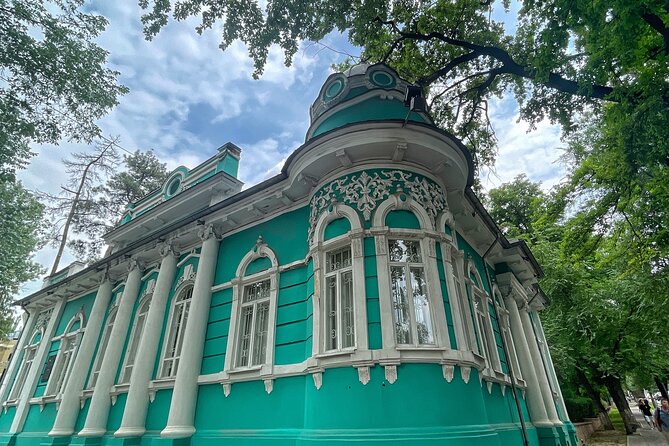
Almaty can be hard to read at first. Its broad streets, mountain setting, Russian-era buildings, Soviet apartment blocks, and newer urban development do not belong to one simple period. This walk gives you a useful framework for sorting those layers.
The guide presents Almaty as a place that changed several times. It began as a small provincial town on the Asian edge of the Russian Empire. It later became the capital of Soviet Kazakhstan, then part of an independent country with its own national identity and architectural choices.
That long view is the best reason to take the tour. You are not simply checking off a cathedral and a market. You are being shown how practical needs shaped the city. Running water, earthquake damage, school construction, public transport, and building decoration all become part of the story.
The tour is also designed for a private group. That matters in a city where architectural details can be easy to miss. You can stop to ask why a building looks the way it does, request more detail about the Soviet period, or spend less time on a subject that does not interest you.
The current rating is 3.8 from five ratings, so I would set expectations carefully. The experience may be enjoyable and informative, but it is not a guaranteed all-purpose introduction to Almaty. It is best understood as an architecture and city-history walk with a humorous professional guide.
More city tours in Almaty:
- Almaty: City tour and Medeu, Shymbulak and Kok-Tobe
★ 4.7 · 163 reviews - Almaty City: Big Almaty Lake Roundtrip Transfer and Tour
★ 4.8 · 110 reviews - Almaty city tour and Medeu-Shymbulak-Koktobe-Green Bazar
★ 4.5 · 65 reviews
Zhibek Zholy connects the modern metro with ancient trade
The meeting point is Zhibek Zholy, one of Almaty’s metro stations. The walk begins here at 11:00 in the morning. A metro ticket is included, and the station provides more than a practical starting point.
Zhibek Zholy refers to the Silk Road. The station’s decoration points toward the ancient trade routes that connected Central Asia with distant parts of Asia and Europe. The artistic treatment gives you an immediate sense that Almaty’s story did not begin with the Russian Empire or the Soviet Union.
I like this opening because it places the city in a much older setting before the walk turns to twentieth-century buildings. You begin underground, surrounded by a modern transport system, while looking back toward the trade routes that helped shape the region.
The station is also described as having its own story, which is useful if you have never used Almaty’s metro. The system is new, and each station has a distinct design. The tour uses that character rather than treating the metro as mere transport.
You spend about 30 minutes at this first stop. Since the tour is on foot after this point, wear comfortable shoes. The supplied information does not give a full accessibility assessment, so anyone concerned about walking or station access should ask the provider before booking.
Panfilov Street brings cafés, opera, and an odd Soviet building
From the station, the walk continues to pedestrian Panfilov Street. This section shifts the mood. You can expect cafés and restaurants, along with a more relaxed public setting than the formal streets around major government buildings.
The architectural surprise here is the central telegraph building. Its shape is compared to a shopping net or string bag, an unusual design for the conservative Soviet period. It is the sort of building that rewards a guided walk because you might otherwise pass it without considering why it looks so different.
The guide also points out the nearby Kazakh opera and ballet theater. Its design combines Asian elements with European classicism. That combination says a great deal about how public buildings in Kazakhstan were expected to represent both local identity and wider imperial or Soviet cultural models.
You spend about 30 minutes in this area. I would pay close attention to the contrast between the pedestrian street, the cafés, and the formal theater. The value is not just in seeing individual buildings. It is in noticing how Almaty presents culture through architecture.
This is also the point where the tour’s limits become clearer. If your idea of a city walk includes a food tasting or time inside a museum, those elements are not part of the stated plan. The cafés and restaurants are visible, but food and drinks are not included.
Kunaev Street explains Almaty’s Soviet expansion
The next section follows Kunaev Street and passes more examples of Stalin-era architecture and residential areas built during the 1940s, 1950s, and 1960s. This is where the tour spends time on the city as a working capital rather than a picturesque old center.
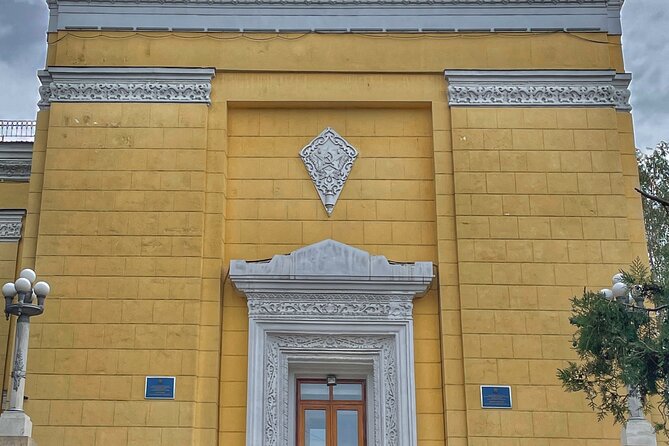
The reference to the Stalin cake house is especially useful. The nickname points to the heavy, layered style associated with Stalin-era public architecture. You get a chance to see how power and prestige were expressed through large formal buildings, even far from Moscow.
The route then reaches the so-called Gymnasium block. Buildings from schools founded under the imperial Russian government survived here from the pre-revolutionary period. Their presence helps connect the Russian imperial city with the later Soviet one.
I like this part because it prevents Almaty from being reduced to a Soviet city. Older institutions and buildings remain in the middle of later development. That kind of overlap is often more revealing than a single perfectly preserved historic quarter.
The tour also addresses practical questions about city life. How did Almaty deal with running water during the twentieth century? Where did local builders obtain sea shells used to face buildings in the 1960s, despite the city being thousands of kilometers from the sea? These details make the architecture less abstract.
You should know that this section can feel academic if you prefer markets, stories about famous residents, or natural scenery. The city’s mountains are not the main subject here. The guide’s attention stays on streets, construction, and the people and systems behind them.
More walking tours in Almaty:
- Almaty: City Highlights Walking Tour with Chocolate Shop
★ 4.8 · 34 reviews - Almaty Walking Tour: 9 Must-See Sights in a Small Group
★ 5.0 · 14 reviews - Almaty Walking Food Tour
★ 5.0 · 11 reviews - Almaty Private Guided Walking Tour With A Guide (Private Tour)
★ 4.5 · 9 reviews
Panfilov Park holds Almaty’s strongest cluster of sights
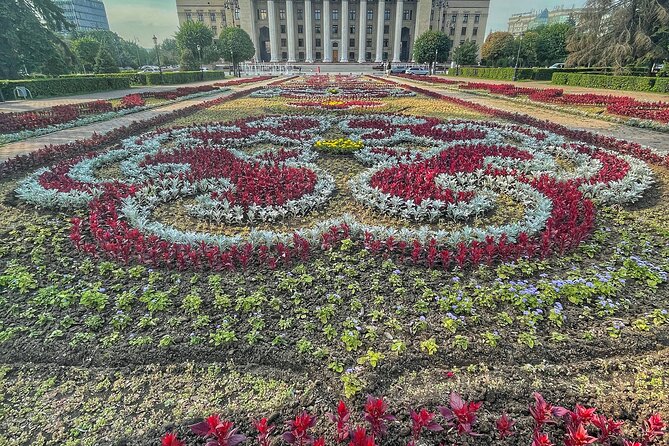
The walk continues to the Park of 28 Panfilov Guardsmen, described as Almaty’s oldest park. This is the most concentrated portion of the route, with several important buildings and monuments close together.
The oldest cathedral in the city is here. It survived the devastating earthquake of 1911, making it a key part of the region’s natural-disaster story. The tour explains how Almaty faced major earthquakes at different times and how the city endured and rebuilt.
That subject adds needed depth. Architecture in Almaty is not only about style. It is also about survival. A building’s age may reflect construction methods, damage, restoration, or the fact that it escaped the worst effects of a disaster.
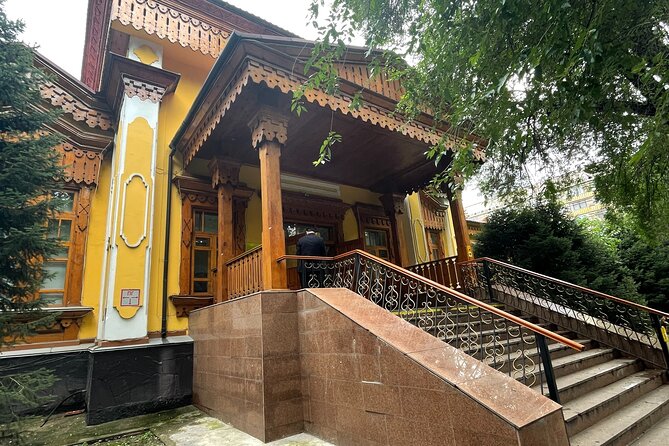
You also see a wooden Russian-style officers’ club. Its material and design make a strong contrast with the heavier masonry associated with later state architecture. The building helps show how different Almaty looked before the Soviet period transformed its streets.
The park also contains an ambitious Soviet monument to victory in the Second World War. Its scale and message reflect the way Soviet public spaces used monuments to shape collective memory. The cathedral, wooden club, and war memorial create a compact lesson in imperial, religious, and Soviet Almaty.
This stop lasts about 45 minutes, the longest scheduled portion before the final choice. I would consider it the heart of the walk. If you enjoy architecture and public monuments, this is likely to be the most rewarding section. If you want a more active or social experience, the extended discussion of buildings may feel slow.
Green Bazaar or Arasan bathhouse for the final stretch
At the end of the route, you may continue toward the Green Bazaar, Almaty’s local farmers market, or return to the original meeting point. The stated timing allows about 45 minutes for this final section.
The Green Bazaar offers a change from formal architecture. A market gives you a more direct look at local commerce and everyday food culture, even though no tasting or purchase is included. If you want the walk to finish with more street life, I would choose this option.
The alternative route back passes the Arasan bathhouse. This traditional bath complex was built in the 1980s and is described as a significant example of the period. It gives the final stretch another architectural subject, this time from late Soviet urban life.
The choice is useful because it lets you match the ending to your interests. Choose the market if you want a livelier public setting and a chance to continue exploring on your own. Choose the bathhouse route if you want to stay with the tour’s main theme.
The wording suggests that the return option brings you back to the original meeting point. The activity ends there, rather than at the market. Confirm your preferred ending with the guide at the start, especially if you have another appointment afterward.
What the $60 price means for your day
The cost is $60 per person. That is not a bargain for a three-hour walking tour, especially for a solo visitor. The value improves if several people join the private group and share the guide’s time.
You are paying for a professional guide, a private format, and a route that connects many periods of Almaty’s development. The metro ticket is included, which is a small but useful benefit. Bottled water is not included, so bring your own.
The private setup is the strongest part of the price. In a large group, a conversation about water systems, imported sea shells, or earthquake construction could become a lecture. With only your group, you can ask for clarification and spend more time on the subjects that interest you.
I would not book this tour purely to save money. I would book it if you value interpretation and want a guide to organize Almaty’s complicated architectural story. If you only need directions to the main sights, you can see much of the route independently for less.
Group discounts are offered, though the exact reduction is not stated. Ask about the discount before paying if you are traveling with friends or family.
Practical details that affect the experience
The listed start time is 11:00 a.m., and the meeting point is Zhibek Zholy in Kazakhstan. Pickup is offered, but the stated start and end point is the metro station, so confirm the pickup arrangement rather than assuming door-to-door service.
The full walk takes about three hours. Each early stop is planned for roughly 30 minutes, while Panfilov Park and the final section receive about 45 minutes each. The pace should be manageable for most participants, but this remains a walking tour, not a seated city sightseeing trip.
A mobile ticket is available. Confirmation is sent within 48 hours of booking, subject to availability. Service animals are allowed, and the meeting point is near public transportation.
Most people can participate, according to the supplied conditions. Still, the information does not specify step-free access, exact walking distance, or restroom stops. Ask the provider if those details matter to you.
Free cancellation is available up to 24 hours before the local start time for a full refund. Changes or cancellations made inside that window are not accepted for a refund.
Who will enjoy this Almaty walk most
I would recommend this experience to you if you like cities as physical documents. You will get the most from it if you enjoy comparing architectural styles, asking why public buildings were designed in certain ways, and tracing change across several political periods.
It also suits a first visit when you want a structured orientation. The route introduces the metro, pedestrian streets, major cultural buildings, a historic park, a market, and a bath complex. You can use those landmarks to plan the rest of your time in Almaty.
The tour is less suitable if your main goal is a food experience, a mountain excursion, or a broad overview of Kazakh traditions. The description includes humor and a professional guide, but the actual subject matter remains strongly architectural.
The critical point is simple: book it for buildings and city development, not for a general culture tour. One rating specifically found the experience more architectural than expected. That is not necessarily a flaw, but it is important to know before you commit three hours and $60.
Should you book the Guided Walking City Tour in Almaty?
Book this tour if you want a private, guide-led walk through Almaty’s architectural layers. The unusual telegraph building, Silk Road metro station, cathedral, earthquake story, Soviet memorials, and choice of Green Bazaar or Arasan bathhouse give the route a clear identity.
I would skip it if you want food included, extensive time inside attractions, or a broad introduction to modern Kazakh life. For the right audience, the private format and historical connections make the price defensible. For everyone else, a cheaper self-guided walk may be the better choice.
FAQ
Where does the tour begin?
The tour begins at Zhibek Zholy metro station in Almaty at 11:00 a.m.
How long does the walking tour last?
The experience lasts approximately three hours.
Is this a private tour?
Yes. Only your group participates in the activity.
Is a metro ticket included?
Yes. The ticket for the metro stop at Zhibek Zholy is included.
Is bottled water provided?
No. Bottled water is not included, so you should bring your own.
Can I cancel for a full refund?
Yes. You can cancel at least 24 hours before the local start time for a full refund. Cancellations or changes made less than 24 hours before the start are not accepted for a refund.
Just added in Almaty
- 2 Days Tour: Charyn Canyon & Black Canyon, Kaindy & Kolsay Lakes★ 5.0 · 6 reviews
- mixed tour (walking and using public transports)+museum★ 5.0 · 1 review
- 2-Day private Kolsay&Kaindy Lake, Charyn Canyon with stay★ 5.0 · 2 reviews
- 2 day tour to Altyn Emel Singing Dune and Aktau mountain★ 4.5 · 4 reviews
- 2 Days Private Kolsai and Kaindy Tour★ 5.0 · 4 reviews
- The Charyn River Canyons Adventure Tour★ 5.0 · 1 review
- Transfer from Almaty to Bishkek or Bishkek to Almaty★ 5.0 · 1 review
- Half Day Private Guided Tour in Almaty★ 5.0 · 2 reviews
Walking Tours, compared.

City Highlights Walking Tour with Chocolate Shop
Read our review →
Almaty Walking Tour: 9 Must-See Sights in a Small Group
Read our review →
Almaty Private Guided Walking Tour With A Guide (Private Tour)
Read our review →
Astana Private Custom Walking Tour with A Local Guide
Read our review →
Browse the lists this tour appears in